Think & Discuss
Quick Check
Inquiry Task
Stronger inference: they must have used watercraft and possessed the ability to plan ahead and act in coordination (open water is hard to cross reliably by swimming or drifting with the currents). Tool technology, group size, and the mode of navigation are indirect inferences requiring support from more site and experimental evidence; they should not be stated outright as "necessarily so."
The criteria include: whether the timing of extinction matches the timing of human arrival; whether similar disappearances occurred on continents or islands that humans never reached; whether there is direct evidence of hunting (cut marks on bones, butchery sites); whether climate records align with the extinction period; and whether regional differences can be explained—for example, the longer coexistence of large animals and humans in Eurasia and Africa. The material from both regions is mostly chronological correlation rather than direct causation, so the prudent judgment is to acknowledge that both mechanisms may have worked together and to analyze them case by case by region and species, rather than insisting on a choice between the two.
The common pattern is this: each time Homo sapiens gained new capabilities for expansion and adaptation, it pushed local ecosystems under new pressure, and species that were large-bodied, slow to reproduce, or highly specialized were often the first to disappear. This is the basic framework of the three waves of extinction. But a common pattern only offers a clue for comparison; specific attributions still need case-by-case examination, and one pattern cannot cover every case.
Goal of this page:Explain why Homo sapiens was able to leave the Afro-Eurasian landmass, and clarify the key role of seafaring ability in reaching Australia (the Sahul landmass).
Before the Cognitive Revolution, all human species—including Neanderthals and Homo erectus—lived within the Afro-Eurasian landmass (Africa–Eurasia). The Cognitive Revolution brought new language, fictional stories, and the capacity for large-scale cooperation, which transformed how Homo sapiens organized groups and reshaped environments, and made it possible for the first time to "leave the Afro-Eurasian landmass."
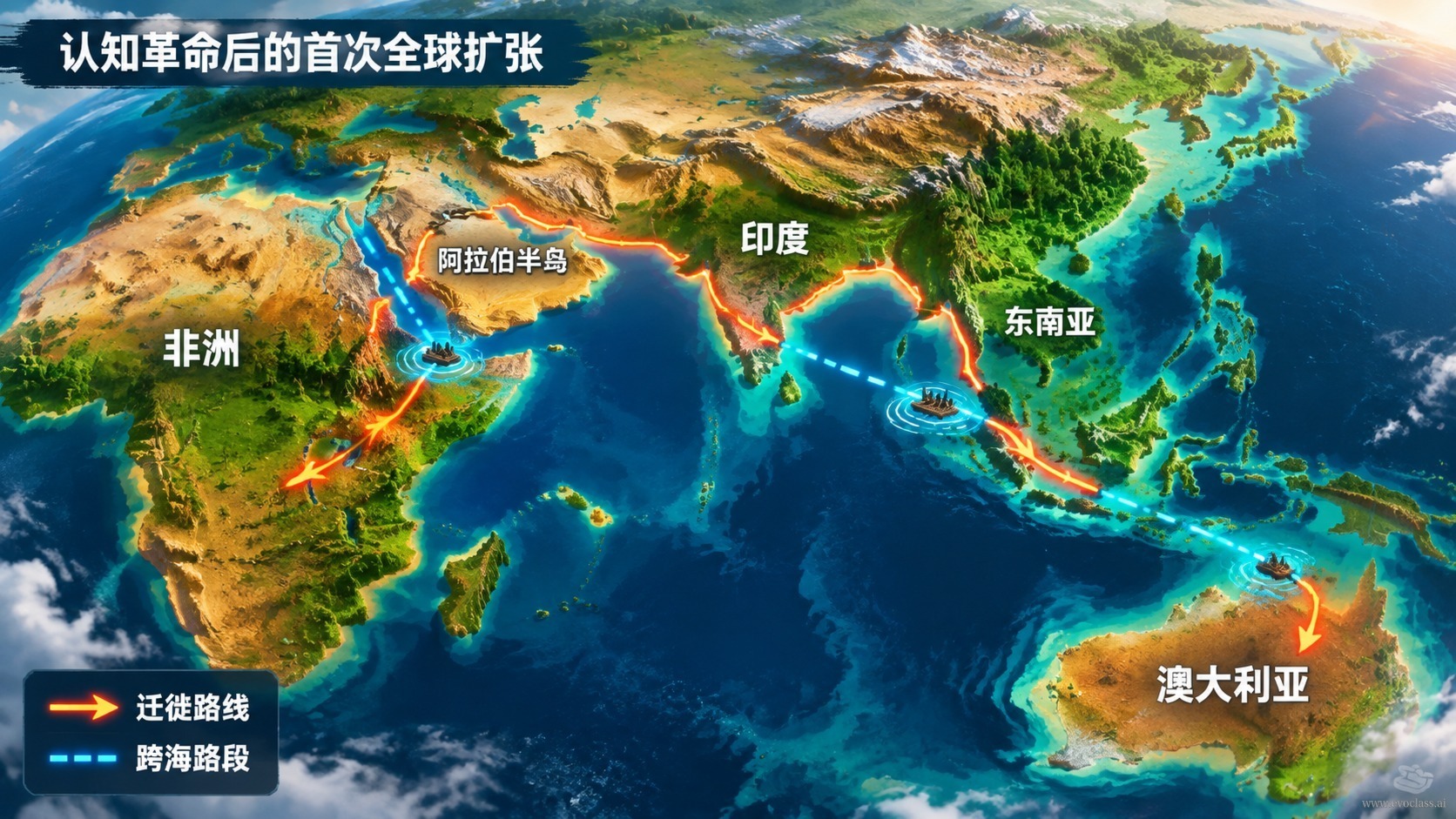
Around 45,000 years ago, Homo sapiens crossed open sea to reach Australia; at the time it was joined with present-day New Guinea, and together they are calledSahullandmass. This is one of the earliest known human migrations that could only be accomplished by ocean crossing.
From the Sunda landmass in Southeast Asia to the Sahul landmass, even at the lowest sea levels of the Quaternary ice age, tens to over a hundred kilometers of open water still lay in between. A land bridge could shorten the journey, but it could not connect the two landmasses: to get across, one had to cross the sea.
Making this leap required an entire set of combined capabilities: watercraft and fishing/hunting technology, navigational and provisioning experience for ocean voyages, larger cooperative groups, and the flexibility to quickly adjust strategies in new environments. All of these are concrete manifestations of the "fiction–cooperation–innovation" capacity: crossing the sea put planning, cooperation, and technology on the table at the same time, and none could be missing.
This is also the watershed between Homo sapiens and other human species of the same period—Neanderthals never demonstrated such seafaring ability.
Definition:Here "colonization" means Homo sapiens entering a landmass where no humans had lived before as a species, not conquering an existing civilization. For tens of thousands of years afterward, Australia was an Indigenous Homo sapiens society, which must not be conflated with later European colonization.
Evidentiary limits:"Around 45,000 years ago" is only the current mainstream estimate. The act of crossing the sea itself is very hard to document directly; we mainly infer it indirectly from site dates, ocean currents, and reconstructions of ancient coastlines, and recent dating disputes have even produced earlier candidate dates. The longer the chain of inference, the more room should be left for the conclusion to be revised.
Significance as a starting point:This expansion opened the path for Homo sapiens to spread across the globe over the following tens of thousands of years, and it also set the stage for the later position of "apex predator" and the ecological consequences of megafauna extinction—this is precisely the starting point for the subsequent discussion of the three waves of extinction.
A world map marking the migration route from Africa to Australia, highlighting the sea-crossing segmentsObserve the world map marking the migration route from Africa to Australia, highlighting the sea-crossing segments, and consider how it relates to "around 45,000 years ago, Homo sapiens crossed open water for the first time and colonized Australia."